

How Safari’s Intelligent Tracking Prevention(ITP) Is Blocking Your Google Ads Tags

how-safaris-intelligent-tracking-preventionitp-is-blocking-your-google-ads-tags

If you’re running Google Ads campaigns, you might notice something strange: conversions look lower than the backend numbers, and delayed conversions (where a user clicks today but buys after a few days) are not showing up . We are discussing how this impacts your google campaigns ability to convert cold audiences especially when you get a good chunk of traffic from Safari and apple devices.

Why does this happen? Because Safari’s Intelligent Tracking Prevention (ITP) is quietly blocking Google Ads tags from tracking users over time.

Here’s what that means in simple terms:

  • Google can’t see the full customer journey on Safari.
  • When a user clicks your ad today but buys later, that “delayed conversion” often doesn’t get reported.
  • At first, this mainly affects your reports — conversions appear to be missing and attribution sucks.
  • But in the long run, Google’s algorithm stops targeting people who take longer to convert, because it doesn’t have data about them.
  • This also affects the dynamic remarketing and RLSA abilities of Google Pmax and smart bidding search campaigns . 
  • As a result, campaigns shift toward only targeting people who are already close to buying — and your google campaigns ability to build awareness or nurture customers disappears.

    In this article, we’ll break down what ITP is, how it works in Safari browser, how it affects Google Ads tracking and retargeting, and why this leads to missing conversions, broken retargeting, and disappointing results when budgets are increased. We’ll also share an example from a real client case to make it easier to understand.

    What Is Intelligent Tracking Prevention?

    Intelligent Tracking Prevention (ITP) is Safari’s built-in privacy guard. Its job is to stop advertisers and websites from following you around the internet using tracking cookies and other techniques.

    Think of it as a bouncer at a club — it watches out for “tracking cookies” and throws them out before they’ve been around too long.

    Why Apple Created ITP

    Apple wants to market Safari as a privacy-first browser. That means limiting “cross-site tracking” — when advertisers track what you do across different websites to show you targeted ads.

    By tightening tracking rules, Apple:

    • Protects user privacy.
    • Differentiates Safari from competitors like Chrome.
    • Makes it harder for ad companies like Google and Facebook to collect data freely.
    How ITP Works

    Websites and advertisers track you using cookies — little files that remember who you are.
    There are two main types:

    1. First-party cookies – from the site you are directly visiting.
    2. Third-party cookies – from other companies’ tools (like Google Ads or Facebook Pixel) loaded on that site.

    Here’s what ITP does:

    • Blocks third-party cookies completely — they can’t even be set.
    • Shortens the life of tracking cookies — if Safari suspects a cookie is for tracking, it can delete it after just 24 hours or a maximum of 7 days.
    • Detects and restricts known trackers — uses machine learning to spot tracking patterns and shut them down.
    • Prevents fingerprinting — hides or randomizes device details to make you harder to identify.
    How This Breaks Google Ads Tracking

    Here’s the problem: Google Ads needs cookies to remember that someone clicked your ad before making a purchase.

    Example:

    1. A Safari user clicks your Google Ad.
    2. They visit your site but don’t buy right away.
    3. A few days later, they come back and buy.

    Without ITP:
    The cookie is still there → Google Ads matches the sale to the ad click → You see the conversion in reports.

    With ITP:
    Safari deletes the cookie after 24 hours or 7 days → When they come back, Google Ads doesn’t know they’re the same person → No conversion recorded.

    Result:

    • Your sales might be fine, but conversions from Safari users disappear from your data.
    • Google Ads gets fewer “signals” for campaign optimization.
    The Hidden Effect on Retargeting & Conversion Lag

    Here’s something many advertisers miss: ITP doesn’t just affect reporting — it also affects how Google Ads’ algorithm works.

    • Safari deletes the cookie and buyer details → Google can’t “remember” the customer journey.
    • That means Google can’t see if someone revisits your site from an earlier click.
    • Because of this, retargeting on Safari is nearly impossible. Google simply doesn’t know it’s the same customer returning.

    So, the algorithm shifts its focus:

    • Instead of guiding people from awareness → consideration → conversion, Google Ads ends up only recognizing people already close to buying (conversion-state customers).
    • As a result, your reports show no conversion lag (because Google can’t connect the earlier awareness/consideration clicks).
    • And if you increase the budget, it often delivers fewer results — because Google can’t bid to nurture awareness-level audiences (those signals are lost)
    Example: A Client Case We Analyzed

    We recently worked with a client who increased their ad budget in campaigns designed to build awareness and consideration.

    Here’s what happened:

    • Traffic increased, mostly from Safari users.
    • Reports showed no improvement in conversion lag.
    • Final results did not increase much, despite the higher budget.

    Why? Because Safari deleted the cookies that would have tracked users from the awareness stage to the conversion stage. Google Ads couldn’t see the full journey, so it optimized only for customers already at the decision point.

    To the client, it looked like the budget increase wasn’t working — but the real issue was ITP hiding the middle part of the funnel.

    Why This Matters More Than You Think

    Safari has a huge share of mobile browsing, especially in iPhone-heavy markets like the UAE, US, and Europe.
    If a large chunk of your audience is on iPhones/iPads, ITP can hide a significant portion of your ad performance.

    What You Can Do About It

    While you can’t turn ITP off for users, you can improve tracking accuracy:

    • Server-side tagging – move tracking from the browser to your server.
    • Enhanced Conversions in Google Ads – uses hashed customer data (like emails) to match conversions even without cookies.
    • Shorter retargeting windows – target Safari visitors within 1–7 days.
    • CRM integration – feed offline or backend sales data directly into Google Ads.
    • GA4 server-side setup – less impacted by ITP restrictions.

    Safari’s Intelligent Tracking Prevention is a big privacy win for users — but a challenge for advertisers.

    Not only does it hide conversions in reports, but it also breaks retargeting and conversion lag tracking, forcing Google Ads to optimize only for bottom-funnel customers. That’s why budget increases often show smaller-than-expected results.

    If you understand how ITP works and adjust your strategy with smarter tracking solutions, you can still get an accurate picture of your campaigns and avoid wasting budget.

    Your Google Ads results may not be as bad as the reports suggest — sometimes, the data is just hidden behind Apple’s privacy curtain.

anees@oriben

Share With

How Enhanced conversions Helps Campaign Optimisation

How Enhanced conversions Helps Campaign Optimisation

Enhanced Conversions is a feature in Google Ads that helps recover those “lost” conversions by using the customer info you already collect (like email, phone, or address) during checkout or form submission.

  • That info is hashed (encrypted into a secret code) before it’s sent.
  • Google then matches this hashed info with its own signedin user database.
  • If it finds a match, Google can confirm, “Yes, this sale came from that ad click.”
The problem it solves

When someone clicks your Google ad and buys something (or fills a form), you want Google to know so it can:

  • Count that conversion
  • Optimize your campaigns
  • Show you accurate results

But — due to ad blockers, privacy updates, or people switching devices, Google sometimes misses that sale or lead.

How Enhanced Conversions Works (Step by Step)
1. A user interacts with your ad
  • Someone searches on Google, clicks your ad, and lands on your website.
  • At this point, Google attaches a unique click ID (gclid) to that visit in the background.
  • If that is a gmail logged in user , Google will be able to identify the Gclid with gmail

2. The user takes an action

  • On your site, the person returns some days later and fills a form (lead) or buys a product (purchase).
  • During this process, they provide first-party data — things you normally collect anyway, such as:
    • Email address
    • Phone number
    • Name
    • Mailing address
3. Your website captures this data
  • The data is captured by your website’s forms or checkout system.
  • Normally, only the conversion event (“purchase completed”) is sent to Google Ads.
  • With Enhanced Conversions, you also send the user data (email, phone, etc.) in a safe way.
4. Data is hashed (encrypted)
  • Before leaving your site, Google Tag Manager hashes this personal info using SHA256 encryption.
  • Hashing means turning “johnsmith@email.com” into a long, irreversible code like 5d41402abc4b2a76b9719d911017c592.
  • This ensures privacy and security — raw personal data is never exposed.
5. Hashed data is sent to Google Ads
  • The hashed info travels securely to Google Ads servers.
  • Google takes that hashed data and compares it with the data it already has from its signed-in users (Gmail, YouTube, Chrome, etc.).
6. Google matches the conversion
  • If the hashed email/phone matches a signed-in Google account that clicked your ad earlier, Google can confidently say:
    ✅ “This purchase came from this ad click”
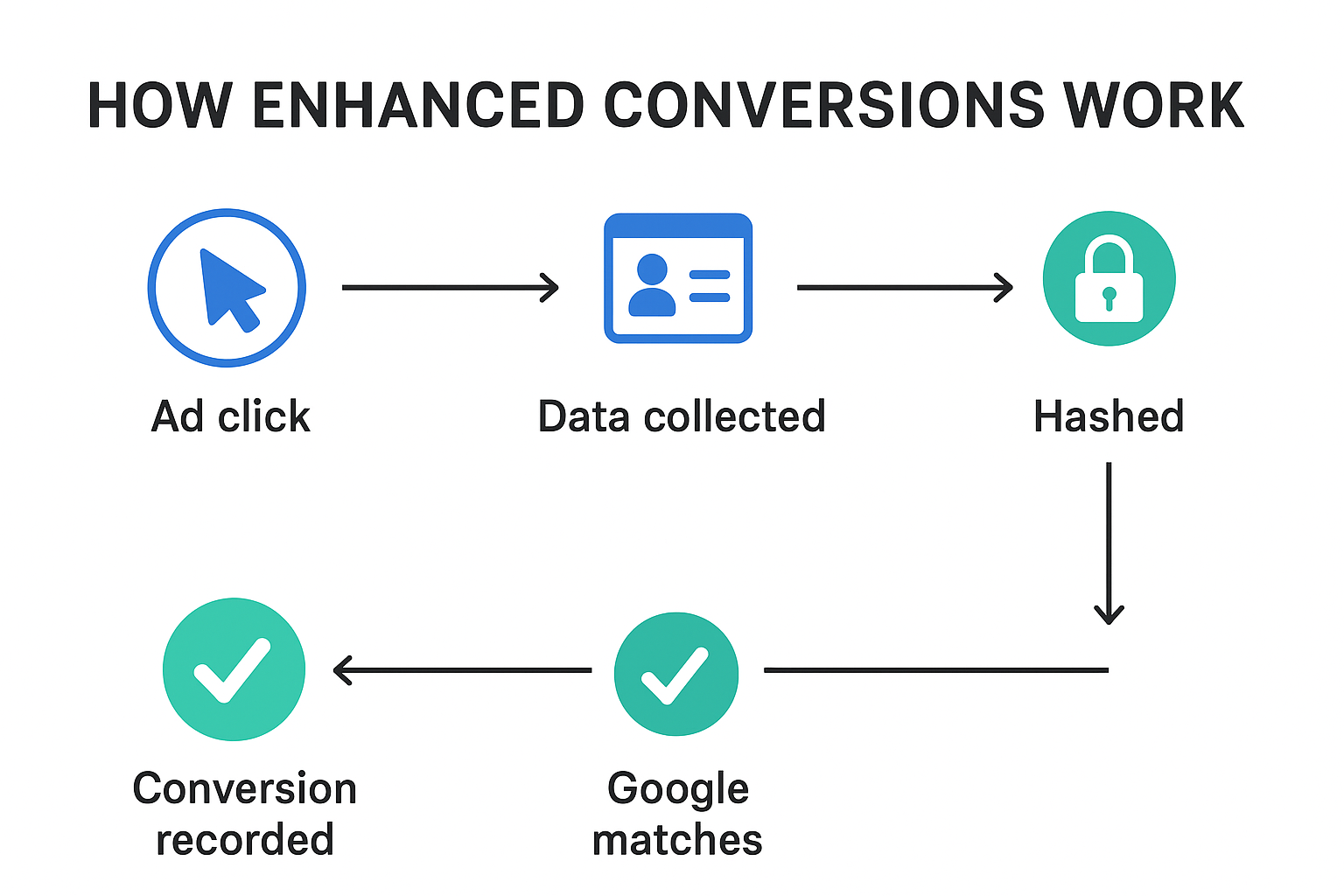
  • The conversion is then logged in your Google Ads account.
7. Benefits
  • The conversion count in Google Ads is more accurate.
  • Smart Bidding strategies (like Target CPA, Target ROAS, or Max Conversions) get better data to optimize campaigns.
  • Even if cookies or ad blockers hide the conversion, Enhanced Conversions helps recover it.
  • The delayed conversions are attributed properly.
  • So campaigns will be able to effectively target cold audiences.
  • The account is better aligned for scaling.
💡 Take away:
  • Without Enhanced Conversions → You see a sale happened, but due to privacy regulated issues your google ads may not be able to connect it back to the ad.
  • With Enhanced Conversions → You can match the sale to the right ad click using the customer’s “secure fingerprint” (hashed data).

anees@oriben

Share With

How ITP and Privacy Features Affect RLSA & Dynamic Remarketing in Google Ads

How ITP and Privacy Features Affect RLSA & Dynamic Remarketing in Google Ads

Online advertising has changed a lot in the last few years. One of the biggest reasons is the growing push for user privacy. Major browsers like Safari, Firefox, and even Google Chrome are introducing tools and restrictions that limit how advertisers can track users.

While this is good news for privacy-conscious users, it creates challenges for advertisers who rely on remarketing — especially RLSA (Remarketing Lists for Search Ads) and Dynamic Remarketing campaigns in Google Ads.

In this article, we’ll explain in detail:

  • How ITP & Privacy features affect RLSA and Dynamic Remarketing
  • How these changes affect your campaign performance
  • And finally, what can you do to overcome this ?

Let’s dive in.

What Are RLSA and Dynamic Remarketing?

Before we get into the challenges, let’s quickly recap how these two campaign types work:

✅ RLSA (Remarketing Lists for Search Ads)

This feature allows you to customize your search campaigns for people who have already visited your website.

Example:

  • Someone visits your online store and checks out a pair of shoes.
  • A few days later, they searched on Google for “best running shoes.”
  • Because they’re on your remarketing list, you can bid higher or show them a more tailored ad than you would for a brand-new user.
✅ Dynamic Remarketing

This takes remarketing a step further. Instead of showing a generic ad, Google uses the products or services the person looked at on your site and shows them personalized ads.

Example:

  • A user browses a red handbag on your site but doesn’t buy it.
  • Later, they see a Google Display Ad featuring that exact red handbag, reminding them to come back and complete the purchase.

👉 Both strategies rely heavily on cookies and tracking tags to recognize the same user when they come back. And this is where ITP comes in.

What Is ITP (Intelligent Tracking Prevention)?

ITP is a privacy feature created by Apple for Safari. Similar protections exist in Firefox (Enhanced Tracking Protection, or ETP) and will soon be fully rolled out in Google Chrome under the Privacy Sandbox initiative.

The goal of ITP is simple:

To stop advertisers and third parties from tracking users across websites for long periods of time.

It does this by:

  1. Limiting how long cookies can last
  • In Safari, first-party cookies created by scripts (like Google Ads tags) often expire in just 7 days or even sooner.
  • Third-party cookies (from ad networks) are blocked entirely.

2. Blocking third-party tracking cookies by default

  • Many remarketing systems need cross-site tracking to work, which becomes impossible.

3. Stripping URL tracking parameters

  • This removes identifiers (like gclid in Google Ads) that help connect a click to a conversion.

4. Preventing trackers from running at all

  • Ad blockers and browser privacy settings can completely block the remarketing tag from loading.

On paper, these sound like small technical details, but the impact on advertising is huge.

How ITP & Privacy Features Technically Affect RLSA and Dynamic Remarketing
🔹 Impact on RLSA (Remarketing Lists for Search Ads)

  1. Shortened Cookie Expiration
  • Normally, Google Ads Remarketing Tags can set a 30-day cookie (or longer) to keep someone in a remarketing list.
  • Under Safari ITP, JavaScript-set first-party cookies expire in just 7 days (sometimes 24 hours if they’re linked to cross-site tracking).
  • This means:
    • Day 1: User visits your site.
    • Day 8: That cookie is already gone — so the user “falls off” your list, even though you set the list duration to 30 days in Google Ads.

2. Blocked Third-Party Cookies

  • If your remarketing tag tries to drop a third-party cookie (from net or googleads.g.doubleclick.net), Safari/Firefox block it instantly.
  • Result: These users are never added to your RLSA list at all.

3. Cross-Device and Cross-Browser Tracking Breaks

  • Without persistent cookies, Google can’t link the same user across mobile + desktop (unless they’re logged into Google).
  • Example: User searches on mobile → visits your site → later searches on laptop. Without login data, Google treats them as two different users.
🔹 Impact on Dynamic Remarketing
  1. Loss of Product-Level Tracking
  • Dynamic remarketing relies on event tags (e.g., view_item, add_to_cart) + product IDs sent via cookies.
  • If cookies are gone:
    • Google Ads receives the visit but can’t tie it to a specific product.
    • Instead of seeing “red handbag you viewed,” the user just sees a generic brand ad.

2. Audience List Shrinkage

  • With 7-day cookies, long buying journeys (like travel, cars, B2B software) suffer most.
  • Example: User browses vacation packages → waits 3 weeks → cookie is expired → they never see your remarketing ads when they’re ready to book.

3. Click Parameter Stripping

  • Safari strips URL identifiers like gclid (Google Click ID) after 24 hours if cookies are considered tracking-related.
  • Without this, Google Ads struggles to connect ad clicks → remarketing tags → conversions.

👉 In short:

  • RLSA lists become smaller and “leak” users quickly.
  • Dynamic Remarketing loses personalization, turning into generic ads.
How to Fix or Reduce These Issues

Now let’s look at the practical steps you can take.

✅ 1. Move to Server-Side Tagging

The problem with client-side tagging (default):

  • Google Ads tags run in the browser.
  • Safari sees them as “trackers” → applies ITP → short cookie lifetime or total block.

Server-side tagging solution:

  • Instead of sending data straight from the browser to Google, the browser sends it to your server/domain first.
  • Example:
    • User visits → browser sends it to https://tracking.yourdomain.com.
    • Your server processes it → forwards it to Google Ads/GA4.

Why this works:

  • Because the cookie is dropped by your own domain, it is considered first-party and not flagged as cross-site tracking.
  • Cookies can last much longer (e.g., 90 days instead of 7).

Tools you can use:

  • Google Tag Manager Server-Side (sGTM) hosted on Google Cloud or your own server.
  • Google Tag Gateway (via Cloudflare) for easier implementation.
✅ 2. Use Enhanced Conversions

The problem: When cookies fail, Google Ads can’t always connect a click → to a conversion → to a remarketing list.

The fix (Enhanced Conversions):

  • Collect first-party identifiers during checkout or lead form submission (like email, phone, or address).
  • Send these values to Google Ads in hashed (encrypted) form.
  • Google then matches these with signed-in Google accounts.

Result: Even if Safari blocks the cookie, Google can still match “John who clicked the ad” with “John who made a purchase.”

✅ 3. Encourage User Sign-Ins

Why this helps:

  • Cookies may fail, but Google can still track users if they’re logged into their Google account (via Gmail, YouTube, Chrome).
  • If you encourage logins (e.g., loyalty programs, gated content, exclusive offers), users are more often signed in → remarketing lists become more accurate.
✅ 4. Adjust Remarketing List Durations

The issue: Safari expires cookies after 7 days.

The solution:

  • Instead of setting remarketing lists for 30–90 days, create shorter lists (e.g., 7–14 days) for Safari/Firefox-heavy audiences.
  • Use “fresher” remarketing windows that capture people while their cookies are still valid.

Example:

  • Instead of “All site visitors (30 days),” create “All site visitors (7 days).”
  • Layer urgency-based messaging like discounts or “low stock” offers to push faster decisions.
✅ 5. Diversify Audience Sources

Since you can’t rely only on cookies anymore:

  • Customer Match → Upload CRM/email lists into Google Ads → remarket to known users.
  • GA4 Audiences → GA4 uses modeling + signals (beyond cookies) to sync audiences into Google Ads.
  • In-App Events → If you have an app, app events feed directly into Google Ads audiences and aren’t affected by browser ITP.

This spreads risk and ensures you’re not over-relying on cookie-based web data.

 Final Takeaway

From a technical perspective, ITP and other privacy features cut off the tracking chain at the cookie level:

  • RLSA loses users when cookies expire early.
  • Dynamic remarketing loses personalization when product-level data isn’t tied to the visitor.

But with server-side tagging, Enhanced Conversions, login strategies, shorter remarketing lists, and diversified audience sources, you can rebuild that chain in a privacy-safe way.

The future of remarketing isn’t about “tracking more” — it’s about tracking smarter with first-party data.

The Bottom Line

Privacy updates like ITP are here to stay. They reduce both the size and accuracy of your remarketing audiences, making it harder to reach past visitors with tailored ads.

To keep RLSA and Dynamic Remarketing working well, you’ll need to adapt — focus on first-party data, invest in server-side tracking, and use multiple audience sources. That way, you can still deliver relevant ads to the right people, even in a more privacy-focused web.

anees@oriben

Share With

How To Use First-Party Data in Customer Match & Enhanced Conversion For Fueling Smart Bidding

How To Use First-Party Data in Customer Match & Enhanced Conversion For Fueling Smart Bidding

Remarketing has always been one of the most powerful tools in digital marketing. It lets you reconnect with people who already know your brand —

For years, remarketing worked by following people around the internet using cookies. But times are changing. Privacy laws are stricter, browsers are phasing out cookies, and users want more control over their data.

This affects the performance of Automated AI powered campaigns and bidding strategies. The RLSA and Dynamic remarketing capabilities make the Pmax and TROAS/TCPA campaigns powerful.

So here we make a plan to use the First Party data in Customer match and Enhanced conversion to fuel the advanced campaign types with the data it was missing from Cookie loss. 

1. Customer Match: Turning First-Party Data Into Audience Power

Customer Match allows you to upload customer details (like email, phone number, or address) into Google Ads so you can create highly valuable audiences.

How to use first-party data in Customer Match:
  1. Upload customer lists
    • Prepare your first-party data (e.g., CRM, purchase history).
      Format it into Google Ads’ accepted CSV template (email, phone, country, zip).
    • Upload in Google Ads → Tools & Settings → Audience Manager → Customer Lists.
    • Google matches them with users logged into their Google account.
      You can then target these people across google
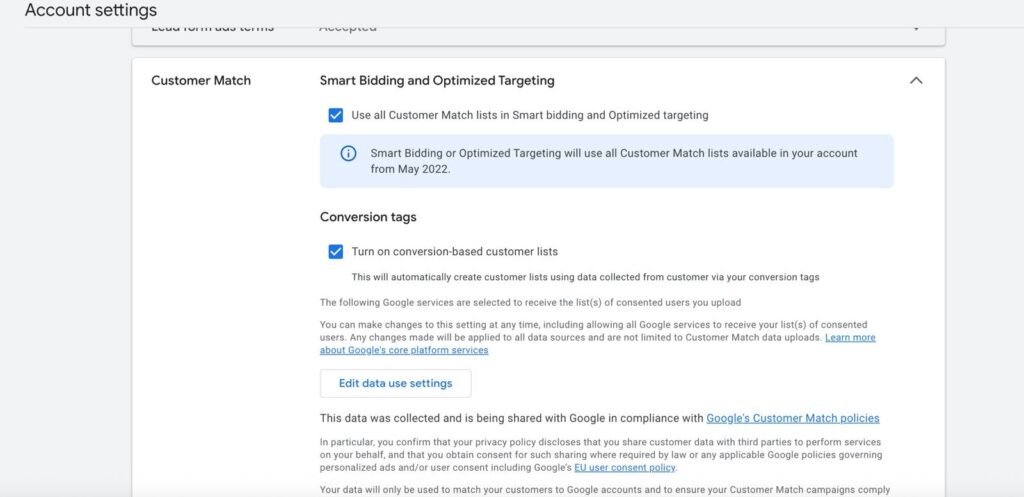
    • In order to power customer match the smart bidding, you need to enable “Smart Bidding and Optimized Targeting” in Customer Match → Account settings

2. Build audience segments
Once Google matches the uploaded data with signed-in Google users, you can:

    • Retarget past buyers with new offers.
    • Exclude existing customers when running acquisition campaigns.
    • Create Similar Audiences (lookalikes) to expand reach.

3. Apply in campaigns

    • Attach these audiences to Search, YouTube, Display, and Discovery campaigns.
      Combine with bid adjustments or let Smart Bidding handle it.
How Google’s Customer Match Algorithm Works with uploaded data
  1. Google “hashes” the data for security.
    • Before uploading, or during upload, the information is encrypted using SHA256 hashing.
    • Hashing converts your customer’s personal info into a string of numbers/letters.
    • Example: customer@example.com → 5f4dcc3b5aa765d61d8327deb882cf99 (hashed form).
    • This way, Google never sees the raw customer data.

  2. Google compares hashed data with its own
    • Google already stores hashed versions of emails, phone numbers, etc., for billions of logged-in users.
    • The system cross-checks your uploaded list against its own database of hashed user info.

  3. When a match is found
    • If the hashed email/phone user uploaded matches the hashed data of a logged-in Google account, that user is added to your Customer Match audience.
    • If no match is found, that record is discarded.
    • After processing, you get an audience list of all matched Google users.
    • These people can then be targeted across Google Search, YouTube, Gmail, and Display Network.

  4. Updating & refreshing
    • Google recommends uploading updated lists regularly. This keeps your Customer Match audience aligned with your real customer base.

💡 Why this matters for bidding:
Customer Match feeds Smart Bidding with audience signals. Google knows these matched users are more valuable, so your bidding strategy can prioritize them automatically.

2. Enhanced Conversions: Feeding More Accurate Conversion Data

Conversions are the signals that Smart Bidding optimizes towards. But if tracking isn’t complete, Smart Bidding is running blind. That’s where Enhanced Conversions comes in.

How to set it up:
  1. Enable Enhanced Conversions in Google Ads → Conversions → Settings.
  2. Pass hashed customer data (email, phone, name/address) through your website tags or Google Tag Manager.
  3. Google uses this data to match conversions more accurately to your ad clicks.
Example:

A user clicks your ad → browses → purchases later via another device. Normally, this may not be attributed. But with Enhanced Conversions, the system uses hashed first-party data (like their email at checkout) to connect the dots and give credit.

💡 Why this matters for bidding:
Enhanced Conversions ensure every possible conversion is tracked and attributed, making Smart Bidding smarter. Instead of missing half the picture, your bidding models are trained on complete and precise data.

3. Smart Bidding: Letting Google Optimize With Better Signals

Smart Bidding strategies like Target CPATarget ROAS, and Maximize Conversions thrive when they receive rich signals.

Here’s how first-party data plays a role:

  • Customer Match audiences → Tell Smart Bidding who is valuable.
  • Enhanced Conversions → Tell Smart Bidding what actions really happened.

Together, they supercharge Google’s machine learning.

Practical ways to use first-party data with Smart Bidding:
  1. Prioritize high-value segments
    Example: Apply Customer Match lists of loyal buyers. Smart Bidding learns these users have higher conversion probability, so it will bid more aggressively when they search again.

  2. Refine conversion value for ROAS
    If you’re running Target ROAS, Enhanced Conversions help ensure higher-value sales aren’t undercounted, letting the bidding system allocate budget more efficiently.

  3. Improve lead quality in CPA campaigns
    For lead gen businesses, Enhanced Conversions for leads (with CRM data) can connect offline sales back to Google Ads clicks. This helps Smart Bidding optimize not just for “form fills,” but for real revenue-generating customers.

Example Workflow Putting It All Together

Let’s imagine an e-commerce brand selling organic spices:

  1. Customer Match
    • Upload past buyers → Target them with new festive offers.
    • Exclude them from generic awareness campaigns.
  2. Enhanced Conversions
    • Pass customer emails from checkout to Google Ads → Track even cross-device purchases.
  3. Smart Bidding
    • Run a Target ROAS campaign.
    • The system learns from accurate sales data (Enhanced Conversions) + high-value buyers (Customer Match).
    • The budget is automatically directed to the best customers at the best bids.

Result will be: More sales at a better ROI, with less wasted spend.

Final Takeaway

By using first-party data in Customer Match and Enhanced Conversions, you give Smart Bidding the right signals to work smarter. Customer Match helps you focus on the most valuable audiences, Enhanced Conversions ensures accurate tracking, and Smart Bidding uses both to optimize your bids automatically. Together, they create a powerful system that drives better results and maximizes your ad spend.

  • Customer Match = Identify and prioritize valuable audiences.
  • Enhanced Conversions = Capture every conversion signal.
  • Smart Bidding = Optimize bids with Google’s machine learning.

The key is not just having first-party data—but using it in the right places inside Google Ads. Do this well, and you’ll give Smart Bidding the best chance to work at full power.

Scaling BigToe Pose, A Mobile Massage Service Company in the U.S.

Scaling BigToe Pose, A Mobile Massage Service Company in the U.S.

🎯 Challenge

The client came to us with one clear goal: more bookings at a lower acquisition cost.
They were running ads—but weren’t seeing returns that justified the spend.

✅ What We Did

Our performance-driven approach focused on improving efficiency, not just increasing traffic. Key actions included:

  • 🔍 Segmented campaigns by user intent (new users vs. remarketing)
  • 🧪 A/B testing multiple landing page variants
  • 🎯 Switched to conversion value-focused bidding strategies
  • ⚡Implemented various Conversion Rate Optimization (CRO) pracices in the landing page.
🚀 The Results

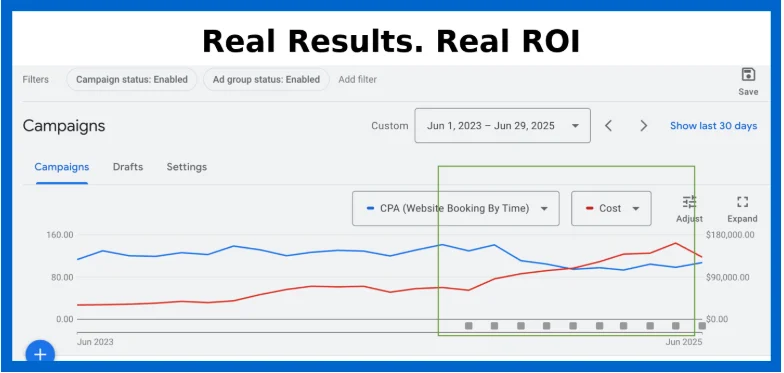
The CPA has fallen by 27% while the budget has been scaled up by 200%.

Since November 2024, the CPA for website bookings has been gradually decreasing as we simultaneously increased the budget.

As of 5 August 2025, the budget has grown by roughly 200%—and we’re still scaling.

MetricBeforeAfter% Change
CPAHighDropped by $41▼ 27.78%
Ad SpendLowerIncreased▲ 200.26%

📉 As shown in the graph below, CPA consistently declined even as budget and bookings increased — delivering exponential ROI.

💡 Outcome

With over 10,000 new bookings generated and cost-per-booking reduced by 27%, the client now scales the budget by 200% profitably while maintaining strong market visibility.

⚙️ Services Used
  • Google Ads Search & Performance Max
  • Landing Page Testing & Optimization
  • Custom Funnel Strategy
  • White-Label Campaign Execution

📞 Want results like this?
We offer white-label services for agencies and consultants. Let’s power your clients’ growth.

Goldrush – Fixing a Broken Marketing Funnel for Better ROI

Goldrush – Fixing a Broken Marketing Funnel for Better ROI

Challenges Identified:

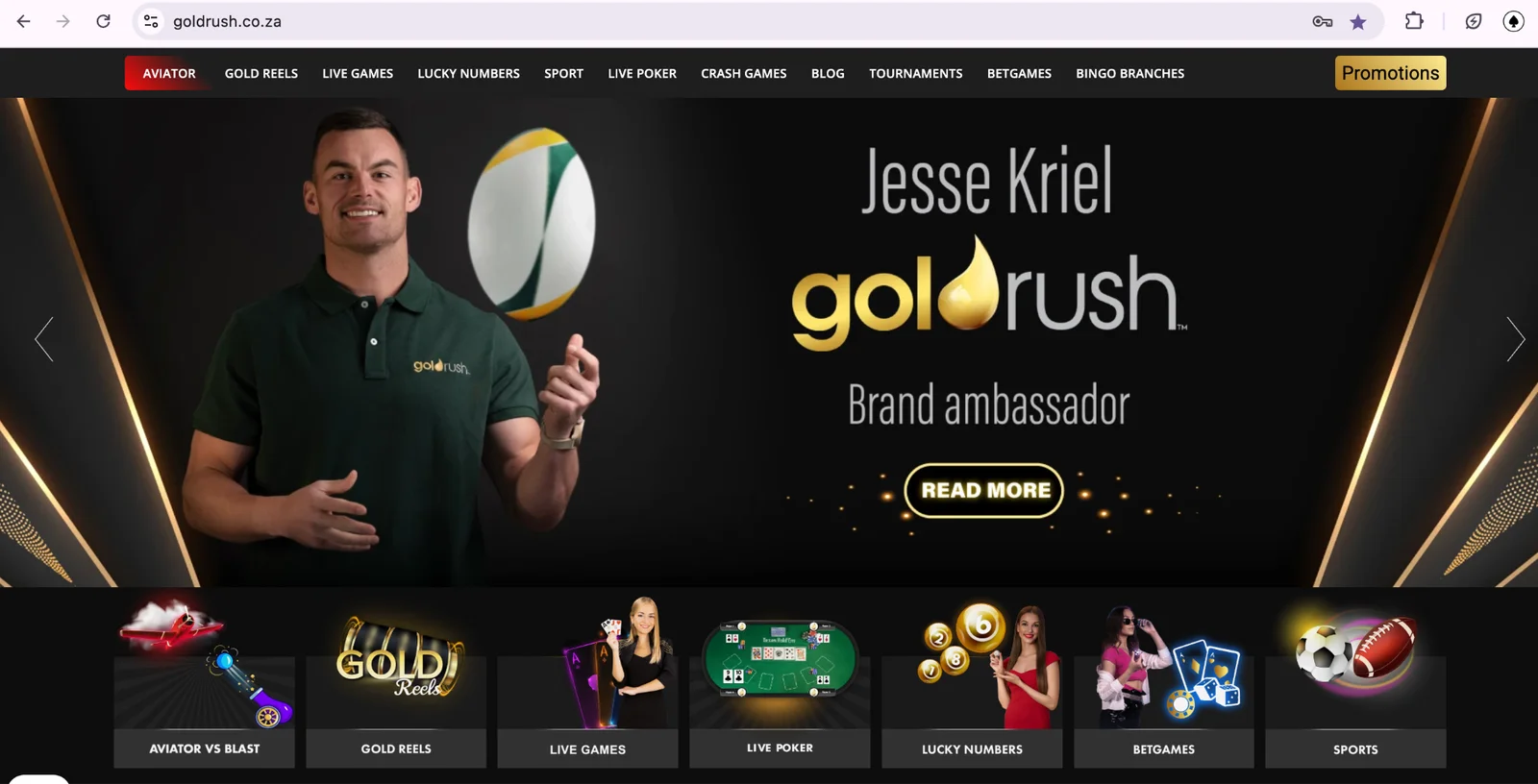
  • Unclear Google Ads setup: Brand, non-brand, and competitor keywords were mixed together, making performance hard to track.
  • Inaccurate data: Duplicate conversions and wrong attribution distorted the real ROI.
  • No clarity across channels: Lots of spend on Meta and native ads, but no idea which clicks actually converted.
  • Misleading performance: Branded campaigns showed low CPA, hiding poor results from new customer acquisition.
  • No focus on long-term value: Decisions were made without looking at customer lifetime value (LTV) or cost to acquire new customers (nCPA).

What We Did (Diagnostic Phase):

  • Data Audit: Cleaned up conversion tracking to remove double-counting and fix last-click bias.
  • Attribution Upgrade: Implemented Wicked Reports to see which channels delivered quality first-click traffic.
  • Channel Comparison: Analyzed performance across Google, Meta, and native ad partners—found two native networks driving most profitable first clicks.

Improvements Made:

  • Google Ads Cleanup:
    • Separated brand, generic, and competitor keywords for better control
    • Fixed conversion tracking to eliminate fake conversions.
    • Reduced branded keyword spend to fund new customer acquisition.
    • Added LTV and new-customer CPA tracking for better decisions.
  • Budget Shift:
    • Scaled top-performing native channels by +50% (without increasing overall spend).
    • Ensured Google and Meta got qualified traffic from native campaigns.
MetricBeforeAfterChange
Total Conversions100%184%+84%
Media Spend100%100%No change
New Customer CPA (nCPA)↓38%More efficient
Branded Spend %42%19%Reinvested in growth

Key Takeaways:

  • Data clarity wins: Removing brand noise and fixing tracking showed the true cost of customer acquisition.
  • Right click matters: First-click attribution highlighted which ads actually drove conversions later.
  • Smarter re-investment: Saving on brand terms funded more high-quality traffic from native ads.

Next Steps:

  • Continue scaling top-performing native platforms weekly.
  • Use LTV data in bidding strategies for smarter automation.
  • Launch ongoing creative testing on Meta to attract more potential customers.
  • Run quarterly audits to keep tracking clean as campaigns grow.

WhiskeyD seen their MER grow

WhiskeyD seen their MER grow from 1.3 to 3.2

This online whiskey provider USA, Texas saw an uplift in purchases and trippled their orders.