
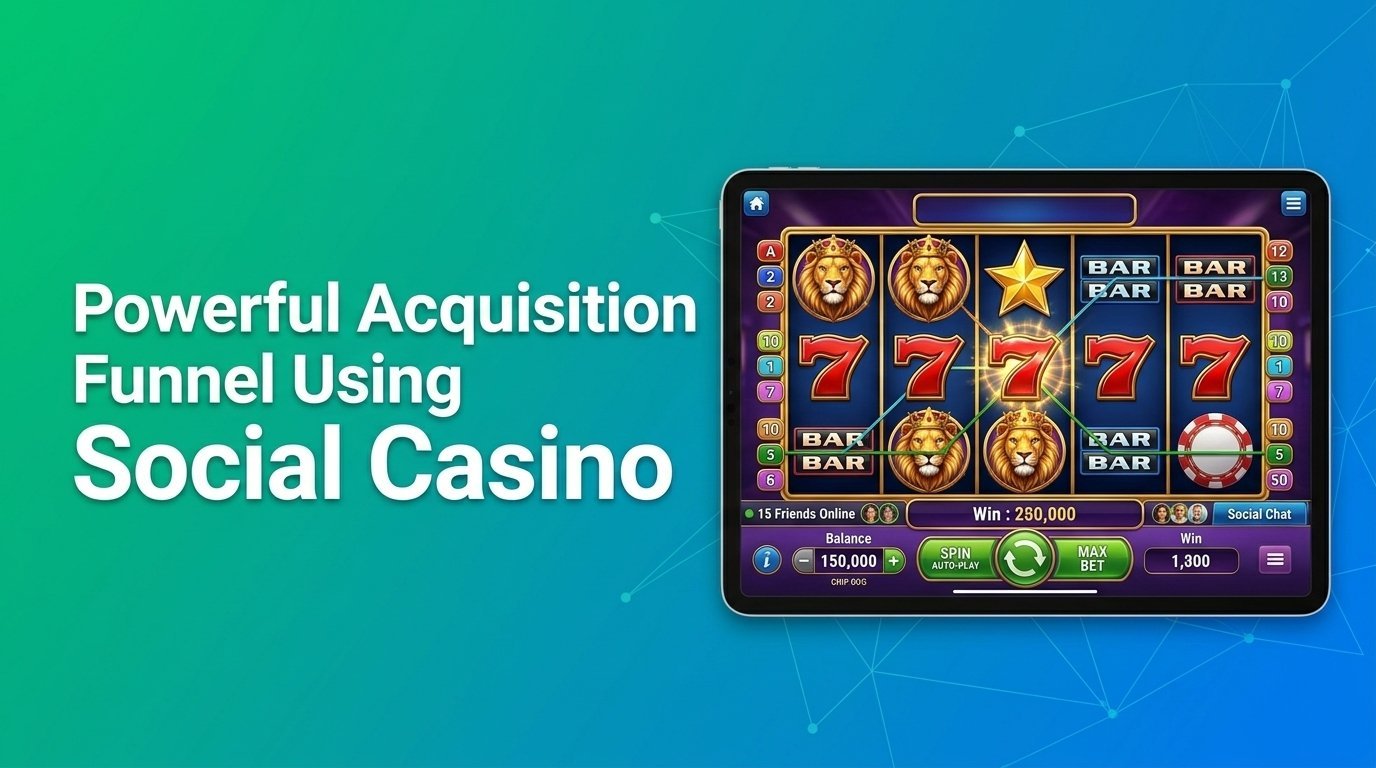
A Smarter Approach to Building Casino Audiences Through Social Gaming
Advertising real-money casinos on platforms such as Facebook and Instagram can be challenging because gambling and gaming fall under restricted advertising categories. Meta requires prior written permission for relevant gambling and gaming promotions, along with compliance with applicable laws and targeting requirements. However , the social casino’s can be advertised freely without any prior written permission.
A genuine social casino offers casino-style entertainment without real-money gambling. When designed correctly, it can become more than just a free gaming product. It can help a casino brand build an audience, collect first-party registrations, increase engagement and create a long-term retention channel.
For licensed operators, including those operating under a Curaçao licence, this concept can be particularly interesting — provided the social casino is a genuine product and the entire customer journey complies with Meta’s policies and applicable laws.
What Exactly Is a Social Casino?
A social casino is a free-to-play casino-style gaming platform.
Users can enjoy games such as:
- Slots
- Roulette
- Blackjack
- Baccarat
- Poker-style games
- Tournaments and challenges
The key difference is that the user is not gambling for real-world monetary value.
For example, a player may receive 10,000 virtual coins and use them to play slots. They may win more virtual coins, but those coins cannot be converted into cash, cryptocurrency, gift cards or other real-world prizes.
This makes the experience fundamentally different from a real-money casino.
Social Casino vs Real-Money Casino
Social Casino | Real-Money Casino |
Free-to-play entertainment | Real-money gambling |
Virtual coins or credits | Real money |
No cash withdrawal | Deposits and withdrawals |
No real-world monetary prizes | Potential monetary winnings |
Focus on gaming and engagement | Focus on wagering |
However, “free to play” does not automatically mean “social casino.”
A platform may advertise itself as a social casino or sweepstakes product but still involve monetary value. Therefore, the entire business model and user journey need to be considered.
Why Does This Matter for Meta Advertising?
One of the biggest misconceptions is:
“If the game is free, Meta will automatically approve the advertisement.”
That is not necessarily the case.
Meta treats online gambling and gaming as a restricted advertising category. Advertisers promoting applicable gambling and gaming products need prior written permission and must comply with applicable laws and targeting requirements.
Meta can also review more than just the advertisement itself. The destination website or landing page and the wider campaign can form part of the review process.
Therefore, a social casino should be a real entertainment product, not simply a page created to disguise a real-money casino.
Why Is Social Casino Interesting for Real Casinos?
This is where the concept becomes valuable for casino marketers.
Imagine a real-money casino brand wants to build a larger audience through Meta.
Instead of immediately asking users to:
“Deposit and play for real money,”
the brand can potentially introduce users to a genuine free-to-play social gaming experience.
The journey could look like:
Meta Advertisement → Social Casino → Free Registration → Free Gameplay → User Engagement → PWA / Add to Home Screen → Returning Users |
This changes the focus from simply buying clicks to building an owned audience and long-term user engagement.
What Does This Mean for a Curaçao-Licensed Casino?
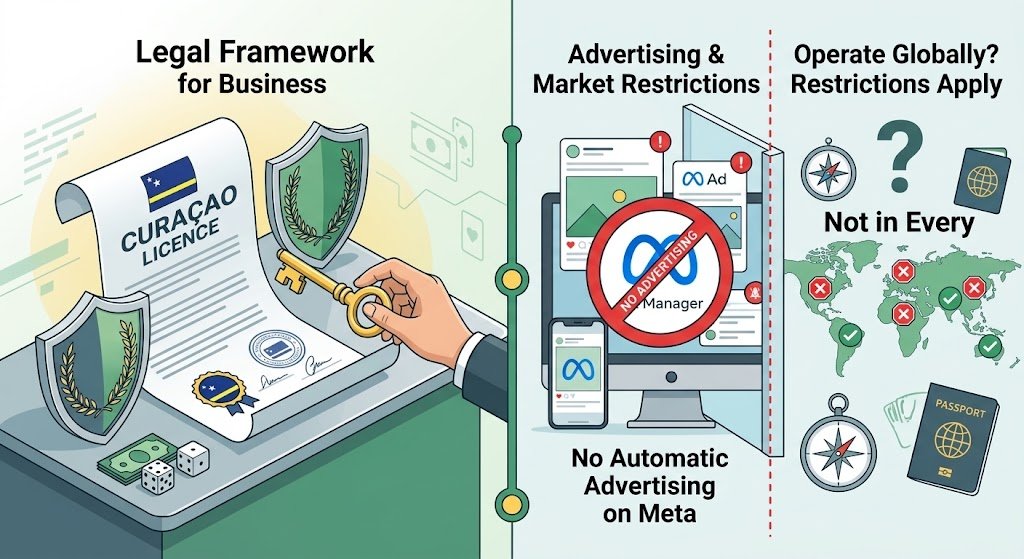
A Curaçao licence can provide a legal framework for operating a gambling business, but it does not automatically give an operator permission to advertise real-money gambling on Meta or operate in every country.
These are separate considerations:
Gambling licence
Determines whether and under what conditions the operator can conduct gambling activities.
Local regulations
Determine whether the product and its advertising are permitted in a particular country.
Meta policy
Determines whether and how the product can be advertised on Meta.
Therefore:
Curaçao licence ≠ automatic Meta approval.
And:
Meta approval ≠ permission to operate gambling everywhere.
A licensed casino considering a social casino strategy needs to evaluate all three areas separately.
The Importance of Country Restrictions
Another important part of this strategy is geography.
There is no universal rule that says:
“Social casinos are allowed everywhere because there is no real money.”
Different countries can have different rules regarding:
- Gambling
- Social gaming
- Advertising
- Age restrictions
- Licensing
- Promotions
- Data collection
Meta can also have its own country-specific requirements.
This means a campaign should always be evaluated country by country.
A useful compliance framework is:
Check | Question |
Product | Is it genuinely free-to-play? |
Country | Is the product legal in the target market? |
Advertising | Is advertising permitted? |
Meta | Does Meta allow the activity in that market? |
Authorization | Is Meta’s required permission available? |
Licensing | Does the operator have the appropriate licence? |
Privacy | Is user data being collected and used correctly? |
Age | Are appropriate age restrictions applied? |
Country and platform rules can change, so any country list should be checked against the latest regulations and Meta policies before a campaign launches.
Social Casino Should Be a Genuine Product
This is one of the most important principles.
There is a major difference between:
A genuine social casino
Users actually receive:
- Free casino-style games
- Virtual gameplay
- Entertainment
- A functioning account
- Non-monetary rewards
- An ongoing gaming experience
and:
A disguised gambling funnel
A user sees a “free casino” advertisement, lands on a fake gaming page and is eventually redirected to a real-money casino.
The second approach can create significant policy and account risk.
Meta also considers attempts to evade its enforcement systems when taking action against advertising assets.
Therefore, the social casino should be treated as a real product and a genuine marketing channel, not as a method of bypassing gambling restrictions.
The PWA Funnel: Turning Acquisition Into Retention
One of the most interesting parts of the social casino model is the PWA — Progressive Web App.
A PWA allows a website to provide an app-like experience. Where supported, users can add the website to their device’s home screen without necessarily downloading a traditional app from an app store.
This creates another opportunity:
Ad → Registration → Gameplay → PWA → Returning User
Instead of losing the user after the first visit, the brand can encourage continued engagement with the gaming platform.
How the PWA Funnel Works
1. Acquire
A user sees a social casino advertisement.
2. Visit
The user lands on the genuine social casino website.
3. Register
The user creates an account.
Depending on the business model and applicable privacy requirements, registration may collect information such as email address or phone number.
4. Play
The user starts playing free casino-style games.
5. Add to Home Screen
The user can be encouraged to add the PWA to their device where supported.
6. Return
The user can easily access the gaming platform again.
7. Engage
With appropriate user permission, web notifications can be used to communicate things such as:
- New games
- Daily rewards
- Game events
- New features
- Entertainment updates
The objective is simple:
Turn a one-time advertising click into a recurring user relationship.
Why First-Party Data Matters
Traditional advertising often looks like:
Advertisement → Click → Website → User leaves
A registration-based social casino funnel can create:
Advertisement → Website → Registration → User Account → Ongoing Engagement
This gives the business an opportunity to build first-party data, subject to applicable privacy and consent requirements.
For example, a registration may collect:
- Name
- Phone number
- Country
- Age confirmation
But collecting a phone number does not automatically give a company unlimited permission to send marketing messages.
Users should understand what information is being collected, why it is being collected and how it will be used. Appropriate consent and privacy requirements must be followed.
From Clicks to Real Engagement
A major advantage of this model is that campaign success does not have to be measured only by clicks.
Consider two campaigns:
Campaign A
10,000 clicks → 200 registrations
Campaign B
5,000 clicks → 600 registrations
Campaign B generated fewer clicks but significantly more registered users.
Therefore, marketers should look beyond:
- CPM
- CPC
- CTR
and measure the complete funnel:
Clicks → Registrations → First Game → PWA → Returning Users
Important metrics can include:
- Cost per registration
- Registration rate
- First-game rate
- PWA add-to-home-screen rate
- Notification opt-in rate
- Day 1 retention
- Day 7 retention
- Day 30 retention
- Cost per active user
- Lifetime value
A Complete Social Casino Acquisition Funnel
The strategy can be visualized as:
META ADVERTISEMENT → GENUINE SOCIAL CASINO → FREE REGISTRATION → USER ACCOUNT → FREE GAMEPLAY → PWA / ADD TO HOME SCREEN → PERMISSION-BASED NOTIFICATIONS → RETURNING USERS → CONTINUED ENGAGEMENT |
This creates three important stages:
1. Acquisition
Bring new users into the social gaming ecosystem.
2. Engagement
Give users a reason to play and interact with the product.
3. Retention
Bring users back through the PWA and permitted communication channels.
Where Does the Real Casino Fit In?
For a real casino brand, social casino can potentially act as an upper-funnel entertainment layer.
Instead of starting the relationship with a real-money gambling message, the brand can first introduce users to its gaming ecosystem through a genuine free-to-play product.
The brand can build:
- Awareness
- Familiarity
- Registrations
- Engagement
- First-party audience
- Retention
Any movement from the social gaming environment toward real-money gambling must then be assessed separately against the applicable gambling laws, licensing requirements, Meta policies and user-consent requirements.
The social casino should never be treated as a loophole for promoting an otherwise restricted gambling product.
What About Real-Money Conversion?
This is where marketers need to be particularly careful.
The objective should not be:
“Use a social casino to hide a real-money casino from Meta.”
Instead, the objective should be:
“Build a genuine social gaming product that creates an engaged audience, while keeping every stage of the customer journey compliant.”
A PWA is a technology and retention tool. It does not create an exemption from gambling advertising policies.
Similarly, having a Curaçao licence does not remove Meta’s requirements.
How Should a Casino Brand Approach the Strategy?
A practical approach can be divided into four stages.
Stage 1 — Build the Product
Create a genuine free-to-play social casino with:
- Casino-style games
- Virtual gameplay
- Clear terms
- Privacy information
- Appropriate age controls
- No real-world monetary prizes
Stage 2 — Review Compliance
Before advertising, evaluate:
- Target countries
- Local gambling laws
- Advertising regulations
- Meta policies
- Required Meta authorization
- Licensing requirements
- Privacy and consent
- Age restrictions
Stage 3 — Acquire Users
Run permitted advertising focused on the actual social gaming experience.
The objective is to convert:
Visitor → Registered User → Active Player
Stage 4 — Build Retention
Use the PWA and permission-based communications to encourage users to return.
The objective becomes:
New User → Engaged User → Returning User
The Bigger Picture
The real opportunity is not simply to generate more clicks.
It is to create a full user-acquisition and retention ecosystem.
Instead of:
Ad → Click → Exit
the model becomes:
Ad → Social Casino → Registration → Gameplay → PWA → Returning User → Long-Term Engagement
That is what makes social casino interesting for real casino brands.
It can potentially provide a way to build awareness and first-party audiences around a genuine entertainment product while creating a stronger retention mechanism.
Final Takeaway
Social casino should not be viewed simply as a “free version” of a real-money casino.
It can be a separate entertainment product, an audience-building channel and a retention tool.
For a licensed casino operator, including a Curaçao-licensed operator, the opportunity lies in building a genuine social gaming experience and using it to develop a long-term relationship with users.
The strategy can be summarized in one simple flow:
Acquire through social gaming → Register users → Engage them → Build first-party relationships → Use PWA and permitted communications for retention. |
But the foundation must always remain compliance.
A genuine social casino is a product.
A PWA is a technology.
Meta advertising is a channel.
A Curaçao licence is a gambling authorization.
None of these individually overrides the requirements of the others.
The strongest strategy is therefore not to find a way around the rules, but to build a genuine social gaming ecosystem that works within the rules while creating meaningful value for both the user and the casino brand.